ASET Quantitative Reasoning: how to solve problems your child hasn't seen
Independent. Not affiliated with the WA Department of Education or ACER.
ASET Quantitative Reasoning, sat in Year 6, gives 351WA Education · 12 October 2026 · Published multiple-choice questions in 351WA Education · 12 October 2026 · Published minutes. It tests reasoning with numbers and information, not school maths, so the skill is reading closely, finding the relationship and checking options.
What does Quantitative Reasoning test?
It checks how well a child uses mathematical and scientific reasoning to solve problems1WA Education · 13 October 2026 · Published. The handbook says the content is very different to what is taught in school1WA Education · 13 October 2026 · Published, so a child who does well in school maths may still find it new.
For Year 7 entry in 2028, Year 6 children sit it on 6 March 20272WA Education · 12 October 2026 · Published, as the third test, straight after the break.
| Quantitative Reasoning | What to know |
|---|---|
| Questions | 351WA Education · 12 October 2026 · Published, multiple choice |
| Time | 351WA Education · 12 October 2026 · Published minutes |
| Options per question | 41WA Education · 12 October 2026 · Published, A to D |
| Suggested pace | about a minute per question1WA Education · 12 October 2026 · Published |
| Wrong answers | no marks taken off for wrong answers1WA Education · 12 October 2026 · Published |
| Place in the morning | Third, after the writing test and the break 1WA Education · 12 October 2026 · Published |
| Weight in the total | The same as each other test 3WA Education · 12 October 2026 · Published |
What skills do the questions use?
The handbook lists four. Your child will need to look at information carefully, find patterns and relationships, solve problems, and spot similarities and differences1WA Education · 13 October 2026 · Published.

| Skill | What it can look like | A question your child can ask |
|---|---|---|
| Look at information carefully | A table, chart, diagram or short description | What exactly does this show? |
| Find patterns and relationships | Numbers or amounts that grow, shrink or repeat | What changes, and by how much? |
| Solve problems | Several small steps to one answer | What do I need to find first? |
| Spot similarities and differences | Two options or two sets to compare | What is the same, and what isn't? |
The middle column is our own reading of the four skills. The handbook does not publish a list of question types for this test.
How do the handbook's examples work?
The handbook gives three example questions: two about chance and one about counting. Here is the method applied to them, step by step.
The chocolate jar
The jar holds three white chocolates and five brown chocolates1WA Education · 13 October 2026 · Published. The first question asks what the chance is that the next chocolate taken without looking is brown, after one white one is eaten1WA Education · 13 October 2026 · Published.
Find what is asked
The chance of brown on the next pick, after one white chocolate has gone.
Sort the information
Start with three white and five brown. One white is eaten, so two white and five brown are left.
Find the relationship
Chance means the brown ones out of all the ones left: five out of seven.
Check the options
Look for five chances in seven. Any option counting out of eight forgot that one chocolate was eaten.
The outfits question
The third example asks how many outfits of shoes, a top and pants can be made from the clothes shown1WA Education · 13 October 2026 · Published. The clothes are in a picture in the handbook, so here is the method rather than the answer.
Find what is asked
One outfit is one pair of shoes, one top and one pair of pants.
Find the relationship
Every pair of shoes can go with every top, and every pair of those can go with every pair of pants. So multiply the three counts.
Check the options
Adding the counts instead gives far too few. Listing a handful of outfits shows why.
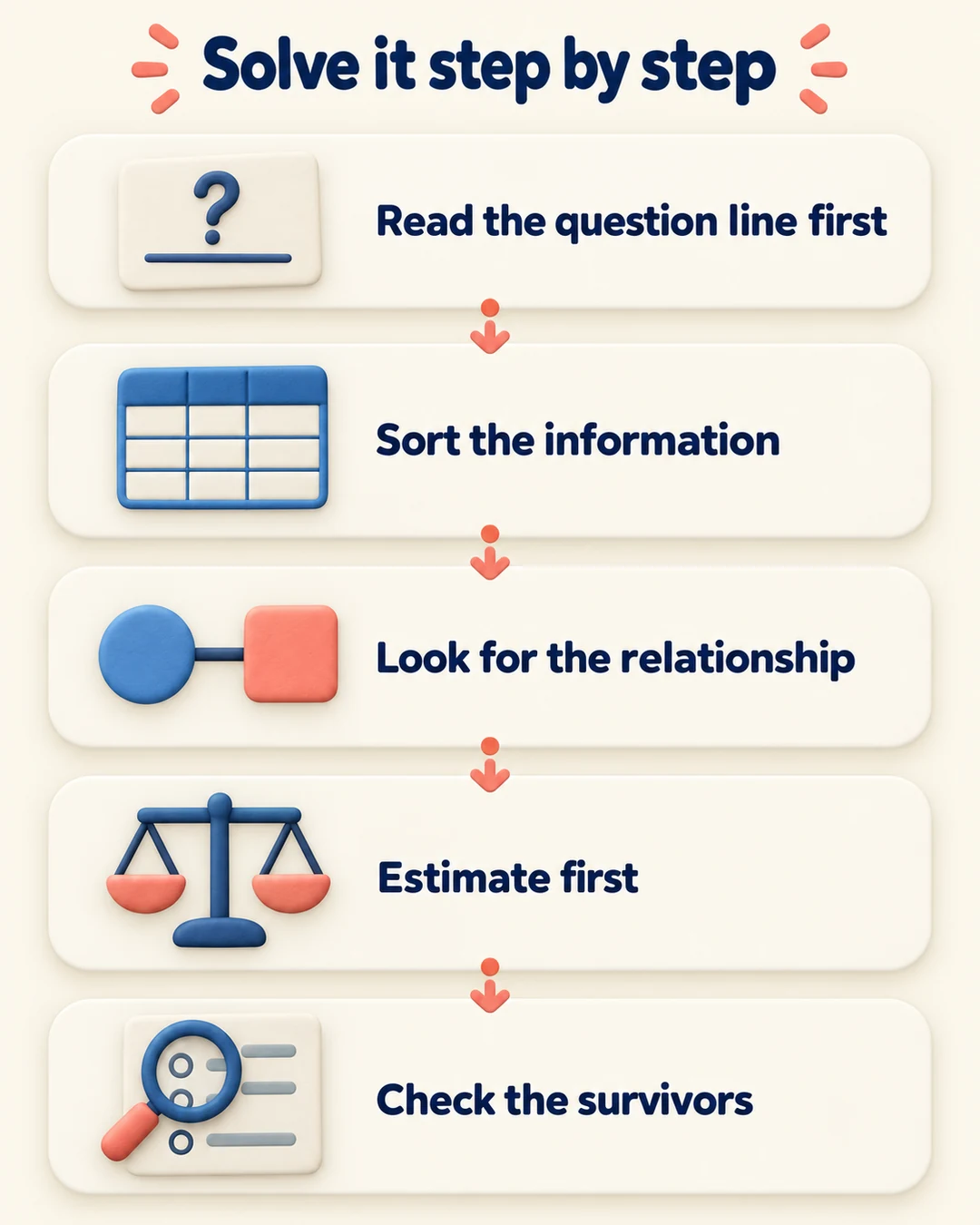
What method works on a problem your child hasn't seen?
The same five steps work on any question, including ones that look strange at first. Practise them out loud until they become a habit.
Read the question line first
Know exactly what you must find before reading the table or story.
Sort the information
Underline what matters and cross out what doesn't. Tables often hold more than you need.
Look for the relationship
A pattern, a rate, a difference between rows or a change over time.
Estimate first
A rough answer rules out options that are far off.
Check the survivors
Put each remaining option back into the problem and see if it works.
How should my child pace it?
The handbook suggests about a minute per question1WA Education · 12 October 2026 · Published. That leaves little room to get stuck, so moving on is part of the skill.
Stuck on a question
Your child should leave its answer space blank and put an asterisk next to the question number1WA Education · 13 October 2026 · Published, then come back if time allows.
Halfway check
Your child should be about halfway through the questions when half the time is left1WA Education · 13 October 2026 · Published.
Unsure between options
When unsure, the handbook's tip is to narrow it to two of the four options by ruling out obvious wrong answers1WA Education · 13 October 2026 · Published.
What traps cost marks?
Most slips in this test come from reading too fast. These four are worth talking through before the day.
Answering a different question
In the chocolate jar, the question is about the next pick, not the first. Read the last line again before choosing.
Using every number
Not every number in a table or story matters. Sort first, then work.
Working that isn't marked
Rough working is fine in the question booklet, but markers never see it1WA Education · 13 October 2026 · Published. Only the shaded answer counts.
Where are the official Quantitative Reasoning samples?
The WA Department of Education publishes them free. We link to them rather than copy them.
| Sample | From | Format | What it gives you |
|---|---|---|---|
| Practice ASET: Quantitative reasoning | WA Department of Education | PDF booklet to print | A full practice section 4WA Education · 12 October 2026 · Published |
| Practice ASET: answer booklet | WA Department of Education | PDF to print | the same answer booklet your child will use on the day4WA Education · 13 October 2026 · Published |
| Practice ASET: answers | WA Department of Education | The key for the multiple-choice questions 4WA Education · 12 October 2026 · Published | |
| ASET Handbook | WA Department of Education | The examples above, with answers 4WA Education · 13 October 2026 · Published |
The year or edition of the practice test: Not published4WA Education · 13 October 2026 · Not published. Practice results do not show how a child will score4WA Education · 12 October 2026 · Published.
How can my child practise at home?
The Department's advice is to read the handbook carefully and try the Practice ASET1WA Education · 13 October 2026 · Published. Everyday problems help too, as long as your child explains each step out loud.
Read the handbook's Quantitative Reasoning pages together 4WA Education · 13 October 2026 · Published
Ask what the question wants before any working starts
Turn shopping, sports tables and timetables into small puzzles
Play simple chance games and ask what is likely, and why
Do the Department's practice section once, timed to the real minutes 1WA Education · 12 October 2026 · Published
Keep it light: the handbook advises preparation in moderation, because most forms of preparation have limits1WA Education · 13 October 2026 · Published
Questions parents ask about ASET Quantitative Reasoning
Is Quantitative Reasoning the same as school maths?
No. The handbook says the content is very different to what is taught in school1WA Education · 13 October 2026 · Published. It rewards careful reading and reasoning more than remembered methods.
Is rough working marked?
No. Rough working is fine in the question booklet, but markers never see it1WA Education · 13 October 2026 · Published. Only the answers shaded in the answer booklet count.
What if my child doesn't understand a word?
Supervisors can't explain a question or say what a word means1WA Education · 13 October 2026 · Published. Your child can often work out the word from the rest of the question.
Does Quantitative Reasoning count more than the other tests?
No: all 4 tests are worth the same3WA Education · 12 October 2026 · Published. A child who finds it hard can make up ground in the other three.