Selective entry Quantitative Reasoning in Victoria: what it tests
Independent. Not affiliated with the Victorian Department of Education or ACER.
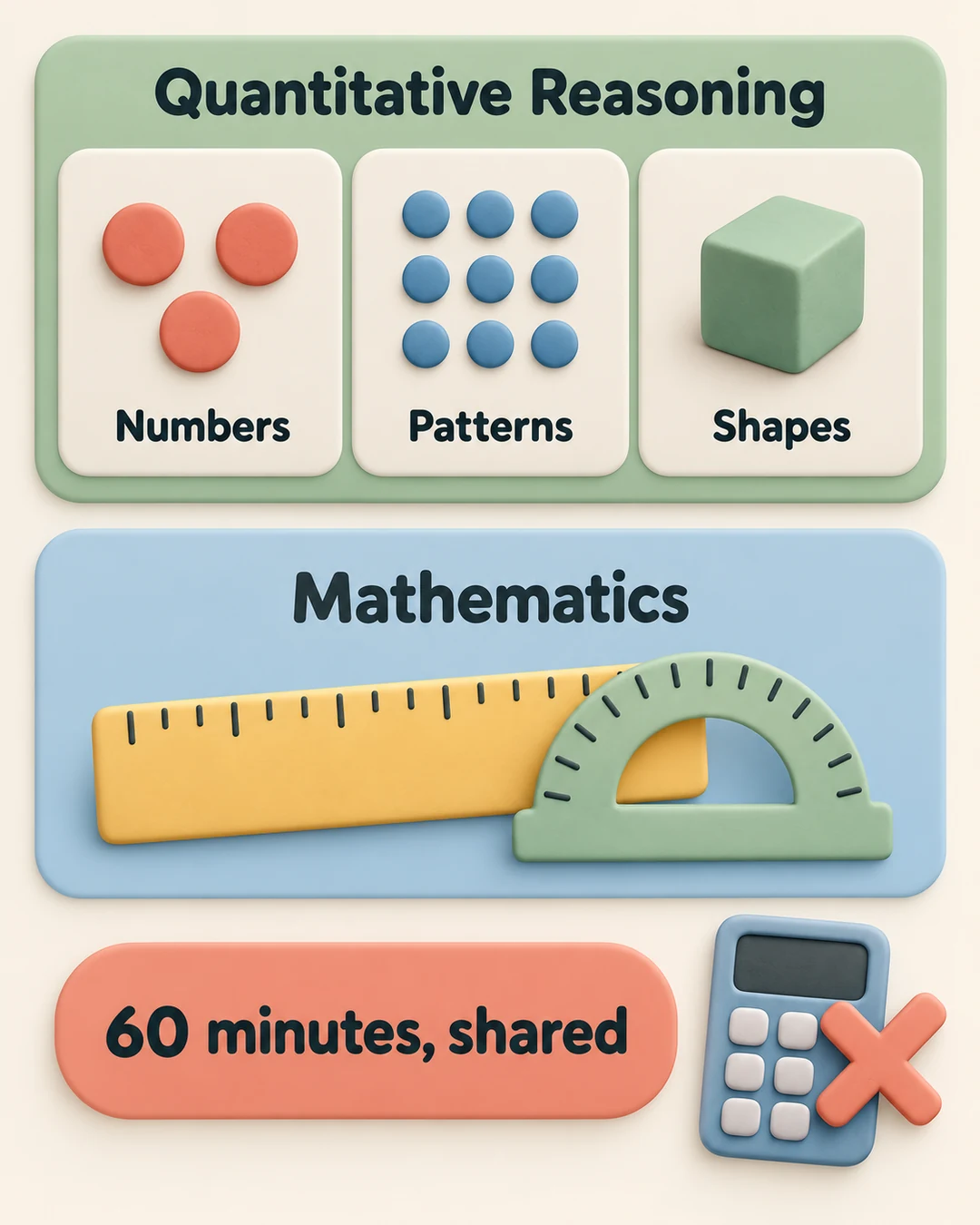
Quantitative Reasoning in Victoria's selective entry exam for Year 9 entry shares a 601ACER · 12 October 2026 · Published-minute sitting with Mathematics. ACER says it tests thinking and reasoning with numbers, patterns and shapes1ACER · 12 October 2026 · Published, and it needs no more than the Year 8 curriculum2Vic Education · 12 October 2026 · Published.
What does the Mathematics and Quantitative Reasoning test check?
It checks school maths and reasoning with numbers, in one timed sitting. Your child has 601ACER · 12 October 2026 · Published minutes for both, and it is the first sitting of the exam morning.
| Part | What ACER says it tests | Time |
|---|---|---|
| Mathematics | year-level maths knowledge and reasoning, and using maths in real-world contexts1ACER · 13 October 2026 · Published | Shared, 601ACER · 12 October 2026 · Published minutes in all |
| Quantitative Reasoning | thinking and reasoning with numbers, patterns and shapes1ACER · 12 October 2026 · Published, in abstract and real-world contexts | Shared with Mathematics |
Calculators are not allowed in the exam room. 3ACER · 13 October 2026 · Published ACER does not publish how many questions there are, or how the parts are weighted. 1ACER · 13 October 2026 · Not published 1ACER · 13 October 2026 · Not published
After this sitting comes a 201ACER · 14 October 2026 · Published-minute break, which is a good moment to reset.
What kinds of reasoning does Quantitative Reasoning ask for?
ACER names three things your child reasons with: numbers, patterns and shapes. 1ACER · 12 October 2026 · Published It publishes no list of question types, so the cards below are habits for each, not a forecast of what will appear.
Numbers
Look for how the quantities relate before doing any sums. Many problems shrink once the link is clear.
Patterns
Find what stays the same and what changes, and by how much. Test the rule on every term you are given.
Shapes
Track one corner or mark as a shape turns, flips or folds. Compare the options by that one mark.
The Department says the whole exam looks at higher order thinking, problem-solving, reasoning, creative thinking, comprehension, interpretation and applying known concepts2Vic Education · 13 October 2026 · Published. Quantitative Reasoning is where that thinking happens with numbers and space.
What method suits structure-first problems?
Use the same four steps on any reasoning problem. They are our method, not ACER's, and they stop your child from calculating before understanding.
Name the kind of problem
Is it a pattern, a shape, a rate or a comparison? Saying it out loud points to the right tool.
Find the structure first
What stays the same, what changes, and by how much? Write it in a few words or a quick sketch.
Simplify
Try a smaller case, round the numbers, or draw it. A simpler version often shows the answer's shape.
Calculate only what is asked
Then check the answer makes sense in the setting, such as a whole number of people.

What are the common traps?
Most lost marks in reasoning with numbers come from rushing the start. These are the traps we see most often.
| Trap | What it looks like | Habit that helps |
|---|---|---|
| Calculating too soon | Long working before the problem is understood | Name the structure first |
| Answering a different question | Giving a total when the question asks for a difference | Underline the last line of the question |
| Losing track in a turn | Picking a shape that is flipped, not turned | Follow one marked corner |
| No sense check | An answer that can't be true, such as half a bus | Ask whether the answer fits the setting |
How is the Mathematics part different?
Mathematics checks the maths your child learns at school, used in real settings. The content needs no more than the Year 8 curriculum2Vic Education · 12 October 2026 · Published, so fluency matters more than new topics.
Know the methods
Keep the school methods quick and accurate, since there is no calculator.
Use them in context
Practise reading a short real-life setting and picking the maths it needs.
Check the answer
Estimate first, then compare. A wild answer usually means a slip, not a hard question.
A child strong at school maths may find the reasoning half less familiar, and the reverse also happens. Practising both side by side makes switching between them feel normal.
How should my child pace a sitting with no calculator?
Your child has 601ACER · 12 October 2026 · Published minutes for both parts, with no published question count. 1ACER · 13 October 2026 · Not published So the aim is steady progress, not a set time per question.
If a problem stalls, ACER suggests your child make an informed guess and come back to it at the end if there is time1ACER · 13 October 2026 · Published. Quick mental arithmetic saves the minutes that a calculator would otherwise save.
ACER says half the questions correct is not unusual1ACER · 12 October 2026 · Published, and many children don't finish. An unfinished sitting is normal.
Where are the official sample questions?
ACER publishes sample questions on its Prepare page, and they cover the style of this sitting too. ACER's own note: free sample questions, not necessarily as hard as the exam1ACER · 12 October 2026 · Published.
| Who publishes it | What it is | Format | Year | Where |
|---|---|---|---|---|
| ACER, the exam's maker | Sample questions for the style and format 1ACER · 12 October 2026 · Published | A download from ACER's website | Not published1ACER · 13 October 2026 · Not published | ACER's Prepare page |
| ACER | Past exam papers | Not released: families get no access to the tests or individual scores4ACER · 12 October 2026 · Published | None | None |
We link to ACER's samples and never copy them. Read our guide to the samples.
How can my child build these skills at home?
ACER says there is no need to practise or revise1ACER · 12 October 2026 · Published. It says the skills grow over time, through a culture of learning, varied engaging material and talking freely about ideas1ACER · 13 October 2026 · Published, and number sense grows the same way.
Do short mental sums in daily life, such as prices, times and distances
Play pattern and shape games: card games, tiling puzzles, folding paper
Ask your child to explain a method aloud before working it out
Try ACER's sample questions once, without a calculator, then talk them through
After any mistake, name the structure that was missed
How is it different from NSW Mathematical Reasoning?
Both ban calculators, but Victoria joins school maths and reasoning in one paper sitting. NSW has a separate maths test on a computer.
| Victoria | NSW Selective | |
|---|---|---|
| Time and questions | Shared 601ACER · 12 October 2026 · Published-minute sitting; counts Not published1ACER · 13 October 2026 · Not published | 355NSW Education · 12 October 2026 · Published questions in 405NSW Education · 12 October 2026 · Published minutes |
| Content level | no more than the Year 8 curriculum2Vic Education · 12 October 2026 · Published | concepts your child already learns at school5NSW Education · 12 October 2026 · Published |
| Calculator | Not allowed 3ACER · 13 October 2026 · Published | No calculator5NSW Education · 12 October 2026 · Published |
| How it's sat | On paper 1ACER · 12 October 2026 · Published | On computers provided by the Department6NSW Education · 12 October 2026 · Published |
Questions parents ask about selective entry Quantitative Reasoning
Can my child use a calculator?
No. Calculators are on ACER's list of items not allowed in the exam room. 3ACER · 13 October 2026 · Published
How many Quantitative Reasoning questions are there?
ACER does not publish the number. 1ACER · 13 October 2026 · Not published
Does my child need maths beyond Year 8?
No. The Department says the exam needs no more than the Year 8 curriculum2Vic Education · 12 October 2026 · Published. Reasoning well with known maths matters more.
Are the samples as hard as the real exam?
ACER doesn't promise that. Its own note on them: free sample questions, not necessarily as hard as the exam1ACER · 12 October 2026 · Published.
Is Quantitative Reasoning the same as Mathematics?
No. Mathematics checks school maths in context, while Quantitative Reasoning checks thinking with numbers, patterns and shapes. They share one sitting and one clock. 1ACER · 12 October 2026 · Published